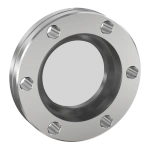

Custom Vacuum Chambers and Fabrication
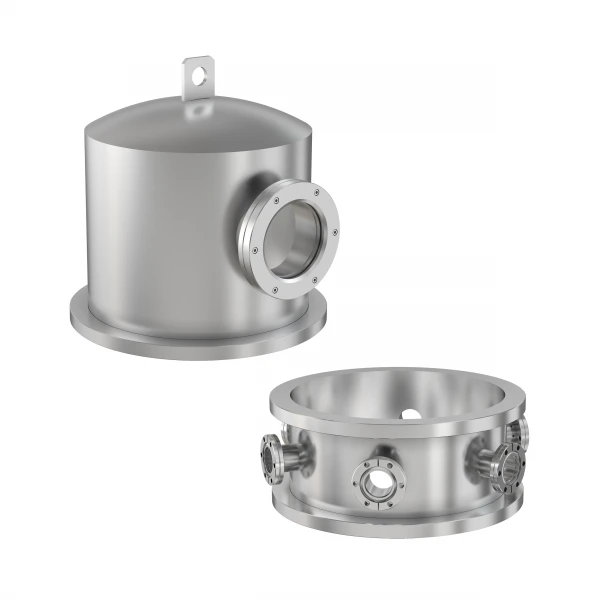
Click to enlarge
Our UHV chamber capabilities include:
- Stainless steel options: 304, 304L, 316, 316L
- Aluminum chambers upon request
- Optional fiberglass wrapping for uniform bakeout and thermal distribution
- Stand-alone or complete assemblies with flanges, manipulators, viewports, and more
- Surface finishes: Bead-blasted, electropolished, or chemically cleaned
- Helium leak tested to ≤ 1×10⁻⁹ mbar·L/sec
- CMM-inspected for dimensional accuracy; reports available
Contact us for more information or request a quote to begin your vacuum chamber order today.
Custom Vacuum Chambers and Fabrication Features
- Aluminum chambers available on request
- CMM-inspected for dimensional accuracy; reports available
- Helium leak tested to ≤ 1×10⁻⁹ mbar·L/sec
- Optional fiberglass wrapping for uniform bakeout and thermal distribution
- Stainless steel options: 304, 304L, 316, 316L
- Stand-alone or complete assemblies with flanges, manipulators, viewports, and more
- Surface finishes: bead-blasted, electropolished, or chemically cleaned
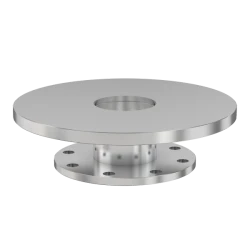
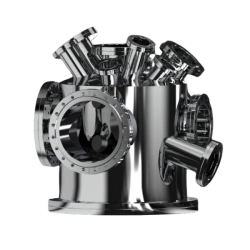
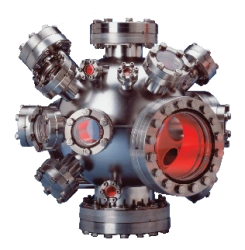
What Are Vacuum Chambers Used For?
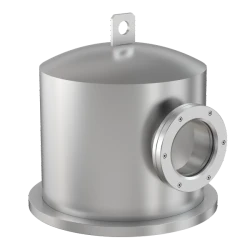
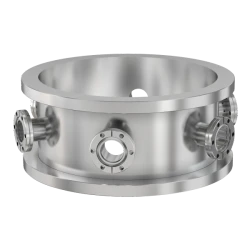
Vacuum chambers are sealed enclosures used to maintain controlled vacuum environments by removing air and other gases. They are used across a variety of industries for projects that require demanding contamination control, exceptional cleanliness, and precise pressure conditions.While available in standard configurations, vacuum chambers are often customized or built to specific dimensions and shapes to support specific requirements. They are made from several components, including: These components make up assemblies for surface analysis chambers and custom chambers and are critical for operational success. At Pfeiffer Vacuum+Fab Solutions, we design and manufacture vacuum chambers to support high performance, cleanliness, and precision for demanding vacuum applications.
Vacuum Chamber Applications
Vacuum chambers are essential for clean, controlled environments. At Pfeiffer, we employ advanced fabrication technology and rigorous quality control processes to ensure the production of high- and ultra-high vacuum chambers with verified leak test integrity, dimensional accuracy, and long-term reliability. Our vacuum chambers can be used for a wide range of applications, including but not limited to:- Distillation
- Drying materials
- High altitude simulation
- Leak testing
- Odor removal
- Plasma treatment
- Removing gases
- Vacuum storage
Industrial Vacuum Chamber Industries
As a leading vacuum chamber manufacturer, we supply standard and custom vacuum chambers for a variety of markets. Many industries require custom vacuum chambers for their applications, including:- OEM manufacturing
- Semiconductor production
- Research and development
- University laboratories
Why Choose Pfeiffer as Your Vacuum Chamber Manufacturer?
Pfeiffer is proud to be a leading vacuum chamber manufacturer, providing standard and custom solutions for a variety of applications. All of our vacuum chambers are manufactured in our facility in Yreka, California, combining time-tested reliability with precision engineering. Backed by decades of vacuum expertise and precision fabrication, we are a trusted source of tailored solutions for high- and ultra-high vacuum applications. For vacuum chambers you can rely on, Pfeiffer is your reliable partner.FAQs: Common Vacuum Chambers Questions
What are the advantages of a Pfeiffer Vacuum+Fab Solutions vacuum chamber?
We know vacuum. All of our chambers are fabricated in-house by world-class vacuum welders. Because our chambers are manufactured in-house, we have control at every step of the fabrication process: design, manufacturing, electropolishing, RGA scans, bakeouts, vacuum testing, and shipping.How can I reduce the cost of a custom vacuum chamber?
Every custom-made chamber is designed to your unique application requirements, goals, and specifications. Pfeiffer’s team of engineers will work with you throughout the entire process to ensure your design balances performance with the best overall value. Factors that can contribute to optimizing costs include:- Reduce the tolerances on the drawing. Tighter tolerances = more production time and higher cost. Simply changing the default tolerance values in your CAD program can reduce costs immediately.
- Use standard components instead of custom-drawn parts. Standard off-the-shelf parts cost less. Working with standard fittings, tubing, elbows, and diameters will reduce the amount of custom work required on a chamber.